BBQ Techniques & Science — Fire Management, Bark, Stall & Smoke
The physics and chemistry behind great BBQ — why bark forms, what causes the stall, how two-zone fire works, and what smoke actually does to meat.
Why BBQ Technique Matters More Than Equipment
The single most common mistake in BBQ is attributing quality to equipment. A $3,000 offset smoker in the hands of someone who doesn’t understand fire management produces worse BBQ than a $200 kettle grill in the hands of someone who does. Technique is the variable that matters.
Every great BBQ tradition — Texas low-and-slow, Argentine asado, Brazilian churrasco — is built on an understanding of fire behavior that takes years to internalize. This guide covers the science behind those techniques so you can compress that learning curve.
Two-Zone Fire Management
Two-zone fire is the foundation of all live fire cooking. One side of the grill has direct heat (coals or flames) for searing. The other side has no direct heat — the “cool zone” — for indirect cooking. By moving meat between zones, you control exactly how much heat it receives and when. Every BBQ tradition uses this principle, whether they name it or not.
The Brisket Stall — What It Is and Why It Happens
The brisket stall is the period — usually between 150°F and 175°F internal temperature — where the meat appears to stop cooking. Internal temperature plateaus for 2-6 hours despite the cooker running hot. This is caused by evaporative cooling: as the brisket’s surface moisture evaporates, it cools the meat at exactly the rate the fire is heating it. The stall ends when the surface moisture is depleted.
Options: push through it (takes patience), wrap in butcher paper (the “Texas Crutch” — speeds the stall but sacrifices some bark texture), or wrap in foil (fastest, softest bark).
Bark Formation
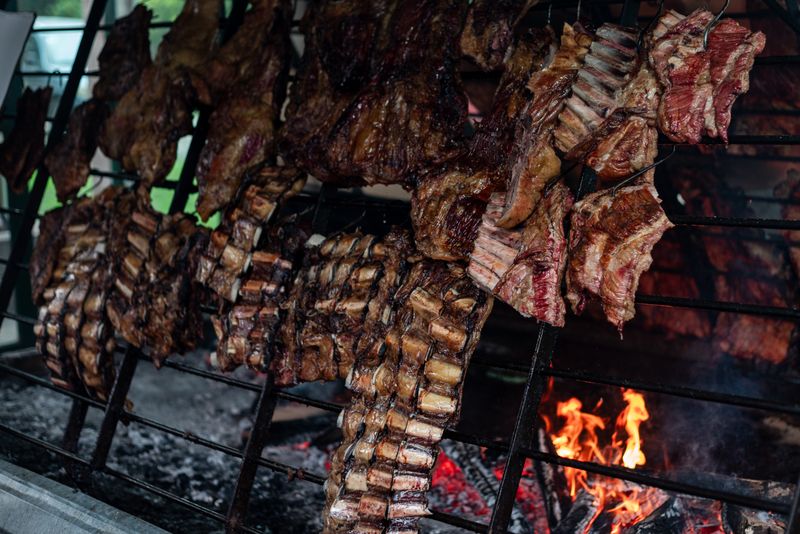
Bark is the dark, slightly crunchy exterior crust on properly smoked meat. It forms through the Maillard reaction (protein browning) combined with moisture evaporation and the polymerization of surface fats. For bark to form properly, the surface must be dry enough for the Maillard reaction to proceed — wet surfaces steam instead of crust. This is why spritzing debates in BBQ are actually about bark vs. moisture balance.
The Smoke Ring
The smoke ring — the pink layer just under the bark — is a chemical reaction between myoglobin in the meat and nitrogen dioxide produced by wood combustion. It is not an indicator of smoke flavor. A thick smoke ring means good wood combustion temperature and sufficient nitric oxide production. It doesn’t mean the meat will taste smokier. Understanding this prevents the common mistake of over-smoking to chase the ring.
Wood Selection
Different woods produce different combustion chemistry. Post oak (Texas standard) produces clean, medium smoke. Mesquite burns hot and acrid — great for fast-cooked carne asada, dangerous for long smokes. Hickory is strong and pairs with pork. Fruitwoods (apple, cherry) produce light, sweet smoke. In South American traditions, quebracho and algarrobo are used for their dense coals and long burn time.
42+ Years of Fire Experience Behind Every Technique
Every technique on 79th Street BBQ is tested over actual fire — not sourced from books. José has been cooking since age 8 in Valparaíso, Chile.
Browse All Techniques → About José